How to Understand Bill Gates's AI Warning About Catastrophic Risk and Weak Regulation
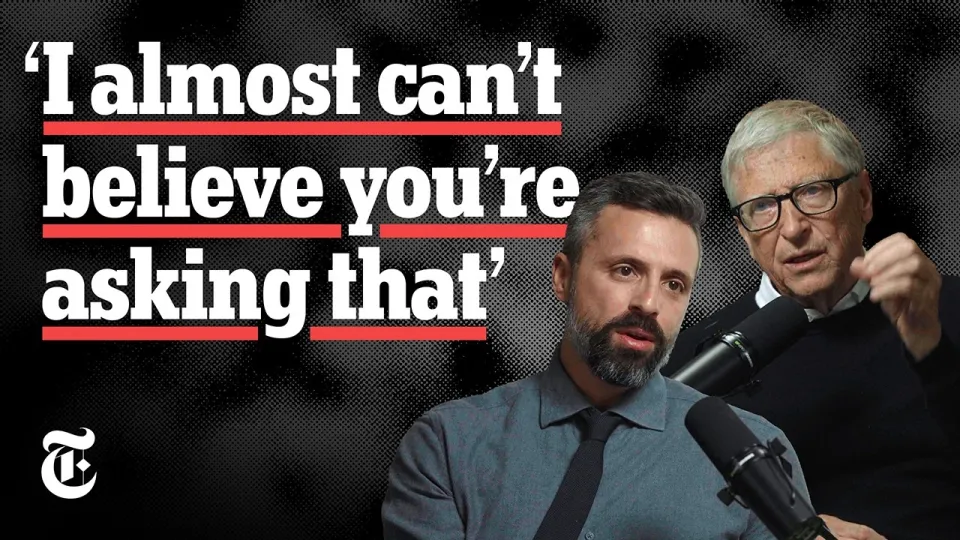
Video: Bill Gates: A.I. ‘Makes Nuclear Weapons Look Like Nothing’ | The Ezra Klein Show
You can order the same kind of articles for your own video to boost it on YouTube and Google. Just message the Telegram bot @sat_sit_bot. The bot writes and publishes the articles itself (with your YouTube video embedded) on popular topical websites (no ads). Your first 50 articles are free.
· based on the channel The Ezra Klein Show
Bill Gates's AI warning comes down to one claim: the technology is advancing faster than the institutions meant to contain it, and the consequences could be worse than anything humanity has faced. In conversation with Ezra Klein, he argues that catastrophic cyberattacks, bio-terrorism and mass job loss are plausible unless governments act, and he calls the idea that the AI industry can police itself "insane." The full interview and transcript are available at the New York Times page for the episode.
Gates is not a newcomer to this debate. As Microsoft's co-founder and chair of the Gates Foundation, he spent years as a technology optimist who saw AI mainly as a tool for health and education. What changed is the speed: models now cross thresholds he once thought were decades away, and he no longer treats alarmism as overblown. If anything, he suggests the alarm has not gone far enough.
What Gates means when he says AI makes nuclear weapons look like nothing
The comparison is about leverage, not body counts: a small group, or even one person, could use AI to cause harm at a scale that previously required a state. Nuclear weapons are expensive, detectable and require industrial infrastructure. Software and biological design tools are cheap, quiet and improving monthly. Gates's point is that the barrier to catastrophic misuse is falling while the safeguards are not rising to match.
He frames the danger around two specific thresholds rather than a vague doomsday scenario:
- Cyber. AI that can find and exploit vulnerabilities faster than defenders can patch them, enabling attacks on power grids, financial systems or hospitals.
- Bio. AI that lowers the skill and cost needed to design dangerous pathogens, turning specialized knowledge into something a wider pool of actors can access.
Both are cases where the damage is done before any court can respond, which is why his argument quickly turns from risk to governance.
Why Gates calls AI self-regulation insane
Gates rejects the industry's preferred answer, that companies will compete their way to safety because harm is bad for business. His objection is historical: markets have repeatedly failed to prevent products that killed people at scale, and the remedy came from regulators, not boardrooms. He is especially dismissive of the idea that liability and lawsuits are a sufficient backstop. A lawsuit arrives after the casualties, and no legal settlement reverses a mass-casualty event.
That is why he keeps returning to government as the only actor with the authority to set thresholds, require audits and stop deployment. The practical version of his argument looks like this:
- Define capability thresholds in advance, so a model that crosses them triggers mandatory review rather than voluntary disclosure.
- Require independent testing for cyber and bio capabilities before release, not after an incident.
- Give regulators power to pause deployment, with real penalties for noncompliance.
- Fund the agencies doing the testing, since under-resourced oversight is the same as none.
The race with China and the safety trade-off
The strongest counterargument to strict rules is that a slow United States hands the lead to a competitor. Gates acknowledges the race but rejects the framing that safety and speed are opposites. His view is that a country that suffers a major AI-enabled attack loses the race anyway, and that shared danger creates room for agreement even between rivals. The comparison to nuclear arms control is deliberate: competitors have managed to set limits when the alternative was unacceptable to everyone.
He is less optimistic about coordination than about capability. The window for setting rules closes as models get cheaper and more widely available, which is why he treats delay as the real risk rather than regulation itself.
How AI could disrupt jobs and what Gates proposes instead
Gates expects mass job loss to arrive faster than previous waves of automation, because AI moves from doing tasks to doing whole jobs. His proposals are less about stopping that shift than about shaping who absorbs the gains:
- Tax AI labor. If machines replace taxable human work, the revenue base erodes; taxing automated labor is one way to keep funding public goods.
- A no-scarcity job market. He imagines an economy where abundance in goods and services coexists with new kinds of work, including care and community roles that markets undervalue.
- "Human reserved" jobs. Some roles, from teaching to certain public services, might be deliberately kept human even when automation is technically possible.
- AI for global languages. Translation and language tools could widen access to education and services in places that never had them, one of the clearest benefits he sees.
He also flags the risk to developing nations, where economic gains from cheap labor can disappear before any safety net exists. That concern connects to his foundation's new priority: making AI a force for equality rather than an accelerant of inequality, backed by a plan to spend down roughly $200 billion over two decades.
Common questions about Gates's position
Viewers of the conversation tend to push back in predictable ways, and Gates addresses most of them directly. One recurring doubt is whether his fear is genuine or performative; his visible frustration when pressed on voluntary safeguards suggests the former. Another is whether he is inconsistent, having spent years praising AI's potential. His answer is that optimism about health and education does not require optimism about unregulated deployment.
A third question is why a technologist would ask for slower progress. Gates's response is that he is not asking for a pause on benefits, but for gates on the specific capabilities that can cause mass harm. A fourth is whether regulation can even work at the pace of AI. His honest answer is that it must, because the alternative is waiting for a disaster to prove the point.
Useful links
- Full episode and transcript of Bill Gates on The Ezra Klein Show
- Book recommendations from guests of The Ezra Klein Show
The takeaway from Gates's AI warning
Gates's message is uncomfortable because it removes the comfortable options: neither the market nor voluntary pledges nor lawsuits will be enough on their own. He is asking for pre-deployment gates on cyber and bio capabilities, funded oversight, and a plan for the labor disruption already underway. Whether or not you share his level of alarm, the case is worth taking seriously, because the cost of being wrong runs in one direction. The conversation was produced by The Ezra Klein Show, and the full transcript is the best place to test his claims against his own words.
Key takeaways
- Gates calls AI the most dangerous technology humanity has approached, saying it makes nuclear weapons look like nothing.
- He names two threshold risks: a catastrophic cyberattack and a bio-terrorism event enabled by AI tools.
- Industry self-regulation is, in his words, insane; he compares relying on lawsuits to stopping a mass-casualty attack.
- Gates Foundation plans to spend down roughly $200 billion over two decades, with AI and inequality as a new priority.
- He warns of mass job loss and argues for tools like taxing AI labor and reserving some jobs for humans.
Source: Bill Gates: A.I. ‘Makes Nuclear Weapons Look Like Nothing’ | The Ezra Klein Show · Markdown version
Questions & answers
Why does Bill Gates compare AI to nuclear weapons?
He is describing leverage rather than raw destructive power. A single actor with AI tools could cause harm at a scale that previously required a state, and the barriers to that misuse are falling faster than safeguards are rising. Nuclear weapons are expensive and detectable; software and biological design tools are cheap and quiet.
What does Gates mean by AI self-regulation being insane?
He argues that companies cannot be trusted to police capabilities that could kill at scale, because competitive pressure rewards speed over caution. Lawsuits and liability only arrive after the damage, so he wants government-set thresholds, independent testing and the power to pause deployment before release.
Will regulating AI hand the lead to China?
Gates acknowledges the race but rejects the idea that safety and speed are opposites. His view is that a country hit by a major AI-enabled attack loses the race anyway, and that shared danger creates room for agreements between rivals, much as it did in nuclear arms control.
What does Gates propose for jobs lost to AI?
He expects rapid displacement and suggests taxing AI labor to protect the revenue base, building toward a no-scarcity job market, and designating some roles as human reserved. He also sees AI translation as a major benefit for global languages and warns that developing economies could lose their labor-cost advantage.